
As European governments warn about possible power cuts, anyone relying on an oxygen concentrator should plan ahead. A backup cylinder isn’t just a safety extra, it’s a vital part of your oxygen setup. This guide explains why the risk of power outages is increasing across Europe, how OxygenWorldwide ensures your protection, and what every traveller or expat oxygen user should do to stay prepared.
Why a Backup Cylinder Isn’t Optional
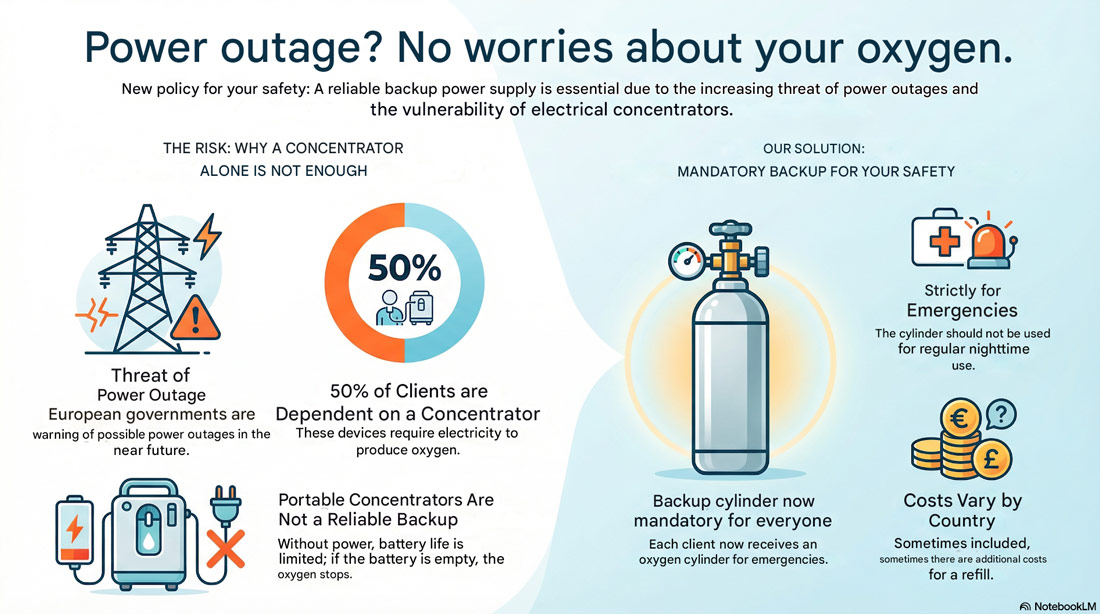
You’ve got your portable concentrator for outings, your stationary concentrator at home, and you might feel you’re covered. That’s a great start. But here’s the catch: when the lights go off, your concentrator stops working. And that’s exactly what several European governments and grid-operators are warning about.
In the Netherlands, for instance, the government lists a power outage as one of the core “disasters and crises” that residents should prepare for ( Gobierno de los Países Bajos) Dutch experts have even flagged possible winter outages if the grid gets overloaded.( NL Times ) Meanwhile in Germany, the Federal Network Agency has stated that if the energy transition falters, occasional supply gaps could arise around 2030. ( Reuters ) And in France the transmission operator Réseau de Transport d’Électricité (RTE) warns that while a full blackout is unlikely, targeted power cuts cannot be ruled out during periods of high demand. ( Reuters )
So, for you as an oxygen user, whether retired, living on the Costa Blanca or somewhere else in Europe, this matters. It’s not alarmist; it’s just practical. You’re depending on equipment that needs electricity… and if the power fails, your portable battery only lasts so long.
How Oxygen Supply Typically Works and Where the Risk Lies
Let’s walk through a typical setup many of our clients use:
- At home (or in your holiday property) you’re using a stationary concentrator, which is plugged into mains power and gives you continuous oxygen supply.
- When you go out or travel, you use a portable concentrator (POC) with a battery.
- Many clients assume the POC serves as backup, great for outings but not enough for an overnight power cut at home.
Here’s where the risk creeps in: if there’s a power cut at your place, the stationary unit stops. You switch to your portable unit… but its battery life is limited. After some hours you’ve exhausted the battery. Then what? No oxygen, unless you have another supply option. That’s where the backup cylinder comes in.
Why the Backup Cylinder Is Non-Negotiable
This is the policy we’re asking you to accept, and here’s why it makes sense.
- Independence from the mains supply. A cylinder gives you a source of oxygen that does not rely on electricity. In a power cut, that independence is a lifeline.
- Designated for emergencies. We supply the cylinder as part of the package, but it is only for emergency use. That means it stays sealed, charged (filled) and ready for when your mains-powered concentrator cannot function.
- Why not night-time use instead of the concentrator? We’ve had cases where clients preferred cylinder use at night because cylinders are silent, and concentrators make noise. But regular use of the cylinder (especially when the concentrator is still available) undermines the purpose of the cylinder, leaving you unprotected for the real emergency.
- Backup included: we strive to provide a backup cylinder wherever possible and unless specifically stated otherwise, every quotation for a concentrator includes the backup cylinder. If the cylinder is used in non-emergency circumstances (for example, nightly use when mains power is actually on) extra costs may apply when it’s refilled. We make this clear so you’re aware.
- It’s about your safety, not upselling. We want you to enjoy your stay, your travel, your independent life with oxygen. This isn’t about pushing extras, it’s about ensuring you remain safe, prepared and independent when the unexpected happens.
Practical Tips for You as a Travelling or Expat Oxygen User
Since you may be living abroad or travelling (for example villas in the Costa Blanca, holiday homes, seasonal stays), here are some practical tips:
- Check power reliability at your accommodation. Ask the property or your holiday-home manager whether they have a backup generator, stable supply and reliable wiring.
Keep the portable unit fully charged. Whenever you leave your home or head out for the evening, ensure your POC battery is topped up. It’s your buffer. - Know where the backup cylinder is stored and how to switch to it. Don’t wait until the power is off to figure this out. View it now. Practice if needed.
- Create an “emergency power cut” grab bag. This may include torch, radio, phone charger bank, water, snacks, your oxygen equipment instructions, contact number for us. The Dutch “Denk Vooruit” campaign reminds citizens that power failure is a real scenario. ( Denk vooruit )
- Keep our contact details at hand 24/7. If the power goes off and you’re uncertain what to do, you can call us. We’re here for you.
- Stay personally informed about grid issues. For example, if you hear from local news or accommodation personnel about a planned outage or maintenance, plan accordingly.
What Happens If the Backup Cylinder Is Used and Why the Policy Matters
We’ve already touched on this, but let’s clarify the mechanics:
- The backup cylinder is supplied as part of the package unless stated otherwise.
Its intended use: only when your mains-powered concentrator is out of service (for instance due to a power cut). - If you use the cylinder as a general overnight or daily substitute (when concentrator/mains power is still available) then:
- We must refill the cylinder sooner.
- That may impose extra costs (you’ll be informed in our client letter).
- This preserves the cylinder’s role as “emergency only” and keeps you fully protected for when a real mains failure occurs.
- If you ever doubt when to switch to the cylinder, call us. Better safe. We’d rather show you how and when to use it than leave you guessing.
Why the Grid Warnings Matter for You
I’ve woven in some real-world grid risks above, let’s pull a few out explicitly and tie them to your situation.
- Netherlands: One report flagged that more than 80% of fire stations lack permanent backup power for major outages. That signals how even emergency infrastructure is vulnerable.
Netherlands: Grid operators warn of “winter outages… in very exceptional situations” because households and companies are consuming more electricity (heating, EVs etc) than the distribution centres can handle. - Germany: The Federal Network Agency warns that if the transition to renewables stalls and flexible demand doesn’t rise, gaps in supply could emerge around 2030.
- France: The grid operator RTE states that although a full blackout is unlikely, some power cuts cannot be ruled out in peak demand scenarios.
- France: In September 2024 RTE placed France at “medium risk” of power cuts for the winter if conditions align.
What this means for you: you may be sleeping in a holiday home, or out at dinner while hooked up to your concentrator, but if the mains supply fails, your equipment stops. Having the backup cylinder is your safeguard.
Final Thoughts – Safety, Independence, Peace of Mind
We believe in helping you live the life you’ve chosen, travelling, relocating, enjoying your overseas home with confidence. Using oxygen doesn’t mean staying put or limiting freedom. It means being smart, prepared and supported.
By accepting the backup cylinder and treating it as your safety net, you keep control of the situation rather than being at the mercy of a sudden power cut. It’s not about fear, it’s about readiness.
If you ever have questions,about how to switch cylinders, how to plan for a stay abroad, what to check in your holiday home, call us. We’re here to help you stay safe, independent and empowered.
Thank you for trusting us. Let’s make your next period away smooth, uninterrupted and worry-free.
Frequently Asked Questions (FAQ)
Q1: When exactly should I switch to the backup cylinder?
A1: Only when your mains-powered concentrator has stopped working because of a power failure, or when you’ve been advised by us. Do not switch simply because you prefer the cylinder for quietness. That is meant for emergency use.
Q2: Does the backup cylinder cost extra?
A2: The cylinder is included with your concentrator quotation unless stated otherwise. Extra costs may only apply if you use the cylinder outside the emergency context (e.g., nightly use when mains power is working) and it needs to be refilled sooner as a result.
Q3: How long will a backup cylinder last?
A3: It depends on your prescribed flow rate and the size of the cylinder. We’ll supply you with a filled cylinder and give you an estimate based on your usage. The key: treat it as your backup, not your primary overnight option.
Q4: I’m staying in Spain (or abroad) for several months. Does this policy apply overseas?
A4: Yes. Whether you are in Spain, on the Costa Blanca or elsewhere in Europe, the principle remains the same. Your mains-powered concentrator depends on electricity, and your backup cylinder gives you continuity in case the power fails.
Q5: What if I discover the power is going off ahead of time (scheduled maintenance)?
A5: Great question. Contact us as soon as you have notice. We can advise whether to switch to the cylinder proactively, or if the maintenance is short enough that your concentrator can still be used safely.
Q6: Can I just not take the cylinder and rely on the portable unit battery instead?
A6: We do not recommend that. A portable unit battery is excellent for going out, but not sufficient for an overnight or extended power cut at home. Without the cylinder, you lose the safety margin.