
Travel Insurance for Oxygen Users: What Every Traveller Must Check
This article explains what travellers who use medical oxygen must check when arranging travel insurance, especially when relying on public healthcare schemes such as EHIC. It clarifies what EHIC does and does not cover, why oxygen delivery often fails despite insurance promises, and how OxygenWorldwide provides a specialist set up service to ensure oxygen is in place before arrival. Using real world scenarios, the article shows how delays, local medical rules, and language barriers can leave travellers without oxygen, and how early planning with OxygenWorldwide removes this risk and provides peace of mind.
You have booked the flight.
You have chosen the hotel.
You have your EHIC card in your wallet and your insurance confirmation printed out.
So everything is covered. Right?
This is where many oxygen users pause. Because somewhere between “I am insured” and “I have oxygen waiting for me”, there is a gap. And it is a gap that surprises people every year, often after they have already arrived at their holiday destination.
This article exists to close that gap. Calmly. Clearly. Without fear. Without jargon.
Because travel insurance, even public schemes like EHIC, is not the same thing as oxygen logistics. And understanding the difference early can save you days of stress, missed holidays, or worse, waiting without oxygen.
Let us walk through what actually matters.
What Travel Insurance Really Covers When You Use Oxygen
Travel insurance is about medical entitlement, not medical logistics.
That distinction is subtle, but crucial.
If you are travelling within the EU, plus Norway, Iceland, Liechtenstein, Switzerland, North Macedonia, or Australia, your E111/E112 card gives you access, in principle, to urgent and some chronic disease related medical treatment during a temporary stay. That can include doctor visits, hospital care, and in some cases follow up treatment.
But here is the part most people overlook.
- EHIC does not arrange oxygen delivery.
- EHIC does not guarantee equipment will be waiting at your hotel.
- EHIC does not bypass local medical rules.
And OxygenWorldwide, equally important to say, cannot arrange medical oxygen under the EHIC scheme.
These are not failures. They are simply how the systems are designed.
Why Oxygen Is Different From Other Medical Needs
Oxygen is equipment. It requires delivery, installation, power, access, timing, and confirmation.
In many countries, oxygen cannot be supplied until a local doctor and often a specialist has assessed you in person. This is due to national regulations and varies widely between countries.
What does that mean in practice?
It means that even if your insurer or home oxygen supplier has assured you that oxygen will be provided, you may still be asked to wait. Days. Sometimes weeks. Especially during busy seasons.
And this is precisely why OxygenWorldwide is so often called after travellers arrive, when it is already stressful.
Scenario A: When everything is approved but Nothing is there
This scenario is more common than people expect.
Your home supplier or insurer agrees to cover oxygen abroad. On paper, everything looks fine. But when you arrive, you are told that before oxygen can be delivered locally, you must visit a doctor. Then a specialist. Then wait for approval.
Local law. No exceptions.
We have seen travellers spend their first week of a two week holiday chasing appointments, sitting in waiting rooms, trying to explain their condition in another language, all while worrying about their oxygen needs.
This is where OxygenWorldwide’s initial set up service exists for one reason only: peace of mind.
Instead of waiting until after arrival, we can arrange oxygen before you travel, delivered one day prior to your arrival, so it is already in place.
- You submit an enquiry or email us.
- We provide a quotation.
- Once accepted and paid, we arrange the oxygen delivery.
After you arrive and attend the required doctor or specialist appointment locally, you send us the prescription by email. From that point, OxygenWorldwide passes delivery and invoicing to a local supplier. In most cases, you continue using the same equipment.
At that stage, part of the initial payment is refunded, minus the set up fee and any non reimbursable days.
This does not replace EHIC. It works alongside it. It removes waiting. It removes uncertainty. It gives you back your holiday.
Manual edit suggestion: you may wish to add a short real example here, such as a traveller who avoided a long delay thanks to the set up service.
Scenario B: When Language Becomes the Barrier
This scenario is quieter, but just as disruptive.
The oxygen was “arranged”.But between your home country and your destination, something was misunderstood. Different languages. Different assumptions. Different systems.
The supplier thinks the hotel will organise access. The hotel thinks the supplier will contact the guest. The guest assumes it is all done.
And suddenly, nothing is there.
This is where OxygenWorldwide’s multilingual coordination becomes critical. We operate in five languages, 24 hours a day, seven days a week. We step in, speak directly to local suppliers, hotels, clinics, and arrange oxygen as quickly as possible.
In this case, we charge your credit card for the supply. There is no refund, but you receive an invoice that you can later submit to your insurer or oxygen supplier at home to attempt reimbursement.
It is not ideal. But it works. And most importantly, it gets you oxygen when you need it.
If you call us from your destination, we can call you back on request, which avoids unnecessary phone costs.
The EHIC Card: Helpful, But Not a Safety Net for Oxygen
EHIC is valuable. Absolutely. Everyone travelling in Europe should carry it.
But it is not designed to manage oxygen delivery. It never was.
EHIC supports medical access, not equipment logistics. It does not override local medical processes. It does not guarantee timing. And it does not ensure coordination between suppliers, hotels, and healthcare providers.
This is why relying on EHIC alone for oxygen is risky, especially for short stays or time sensitive trips.
That is not a criticism. It is simply understanding how the system works.
What You Should Always Check Before You Travel
If you use medical oxygen and are planning a trip, especially in spring or summer, here is what truly matters.
- Confirm your medical clearance with your doctor
- Understand whether your oxygen needs are stable
- Know that EHIC does not arrange oxygen delivery
- Ask whether local laws require a doctor visit before oxygen can be supplied
- Decide whether you want oxygen guaranteed on arrival or are willing to wait
- Plan early, especially for popular destinations
That last point is key. Early planning removes most problems.
How OxygenWorldwide Fits Into This Picture
- OxygenWorldwide does not sell insurance.
- We do not replace EHIC.
- We do not make medical decisions.
What we do is coordinate oxygen logistics in the real world.
- We check availability.
- We arrange deliveries.
- We speak to hotels.
- We navigate local rules.
- We provide a safety net when systems fail to align.
And we have been doing it since 1993.
For many travellers, that coordination is the difference between staying home and travelling with confidence.
A Final Thought Before You Book
Most travellers who call us say the same thing.
“I thought I was covered.”
They were. Just not in the way they assumed.
Insurance and EHIC protect your access to care. OxygenWorldwide protects your access to oxygen.
When those two work together, travel becomes possible again.
If you are planning a trip and want to be sure your oxygen is in place when you arrive, fill in the travel enquiry form on our website or contact our team directly. We will explain your options clearly and help you decide whether an initial set up service is right for your journey.
Good preparation is the best form of reassurance.
Frequently Asked Questions
Does EHIC cover oxygen delivery abroad?
No. EHIC covers access to medical care, not the logistics of oxygen delivery.
Can OxygenWorldwide arrange oxygen under EHIC?
No. OxygenWorldwide cannot arrange oxygen under the EHIC scheme, but we can provide an initial set up service to ensure oxygen is in place before arrival.
Why might I have to see a doctor locally before receiving oxygen?
Many countries require local medical assessment before oxygen can be supplied. This varies by country and can cause delays.
Can I claim OxygenWorldwide costs back from my insurer?
In some cases, yes. We provide invoices so you can attempt reimbursement, but this depends on your insurer.
Is the set up service refundable?
Partially. Once local supply takes over, OxygenWorldwide refunds the amount minus the set up fee and any non reimbursable days.


Wintering in the Mediterranean with Oxygen: A Long Stay Guide
This article helps oxygen users who want to spend the long winter months in the warmer Mediterranean region detailing long stay travel with medical oxygen planning (how-tos, what you’ll need, and lists you’ll need to make before you start), discusses the available equipment and any advantages and drawbacks to each piece. You will also learn about the importance of having a back-up plan and back-up equipment, and highlights the many ways in which OxygenWorldwide can offer step-by-step support to your medical oxygen holiday planning, offering reassurance, practical assistance, smooth logistics and more.
Dee was diagnosed with COPD after a lifetime on a factory floor, sewing fabric and inhaling small threads and particles – much of her working life was complete before health and safety regulations were strictly enforced in the workplace. Dee is lucky in that her COPD is relatively mild and if she takes care about her lifestyle, she manages very well in retirement. Recently, Dee went to Portugal to get away from the brutal damp of a UK winter, and found the climate to be absolutely wonderful. Sitting on her hotel terrace, in the soft winter air, she wondered if she would be able to come back next winter – maybe for the whole winter. The problem, Dee thinks, is that by next winter she will need more intensive medical oxygen than her current occasional use – her doctor has warned her of that much.
Dee got in touch with OxygenWorldwide and we were quickly able to reassure her that yes, she absolutely could arrange a steady supply of medical oxygen for a multi-month stay in Portugal – especially in Portugal (and Spain and France too) as OxygenWorldwide has particularly strong contacts in those countries. Dee’s dream of wintering in Spain with oxygen is not only achievable, but it is far easier and simpler than she thought with the right preparation – OxygenWorldwide has experience with helping many oxygen users to travel widely.
Why the Mediterranean Works for Long Stays with Oxygen
The Mediterranean has a wonderful mild climate in winter, and most of the towns are easily walkable – close enough that most venues are reachable in twenty minutes or so and accessible enough for many mobility aids to be used (with some caveats and exceptions – do check the guidebooks for specific information if you have especial trouble getting about). While the busiest resorts do fill up, especially during the peak holiday season, there are usually a host of small villages and hamlets along the coast where you can find reasonably priced accommodation for the duration of your stay. Even in these ‘remote’ areas, healthcare offerings are good, so you will be able to find a pharmacy or doctor’s surgery easily, and the electricity supply tends to be uniformly good, so you don’t need to worry about your batteries running out without being able to recharge them. And this often leads into the next point, which is that most of these places have easy access for the clients – and for delivery personnel bringing your oxygen equipment and refills!
OxygenWorldwide will liaise with the accommodation manager to ensure that your oxygen can be brought on site and installed in your room before you arrive to take up your winter residency, so you can confirm your bookings with a light heart and clear mind.
Donna and Trevor have visited a tiny Spanish village every winter since Trevor’s retirement. His severe asthma loathes the cold, so they come out to Spain towards the end of October, and stay until March, beautifully looked after by Pilar and her mum. They tried it for one year, and were so delighted with the ease of using OxygenWorldwide to ensure a reliable oxygen supply that they have returned every year since – they’re currently planning their twelfth visit!
Step One: Get Medical Clearance for a Longer Trip
Whenever you travel while you are using medical oxygen on a regular basis, you should make sure that you inform your medical team of your plans. This is almost more important for longer stays, as you may need to discuss changing oxygen needs, should your condition improve or progress while you are away. Your doctor will consider your flowrate, the equipment you’ll be using and the progression of your illness. But don’t worry – even if your doctor does recommend changing your prescription when you are going to be away for the whole winter, this doesn’t mean that you can’t go. You can still travel with your revised prescription.
Step Two: Choose the Right Equipment for a Long Stay
Visiting a country for just a few days requires different equipment than you would need for a longer visit. For example, portable oxygen concentrators are great for mobility, but if you are going to be based in one room for three or four months, you will more likely be recommended to use a large static oxygen cylinder for night treatments. You can also access stationary concentrators that are bigger and quicker than the portable variety, and – occasionally – LOX tanks might be available if you have a high required flowrate and the destination country allows access to LOX.
NB: In the USA, no oxygen can be carried on a flight, but there is occasionally space for empty only cylinders to be carried as checked luggage. There is no cross-border oxygen system for the USA, so you might be better off sourcing a bigger oxygen concentrator for long term travel.
Europe, and the Mediterranean countries, are a little more relaxed, but you should always plan for power considerations, having the right space available for your equipment, whether on your mode of transport or in your accommodation – and you should always have a backup support system. This is where OxygenWorldwide comes in: we can help you source a new oxygen supply should your existing supply fail for any reason, or if you have to move to another hotel or village for any reason.
Step Three: Sign Up with OxygenWorldwide Early
Going anywhere for a long period requires more planning than shorter trips when one-off supplies can be organised relatively easily. But needing a sustained supply of refills and top-ups requires more input: so starting the process as early as possible makes it easier for us to ensure the logistics of your trip are seamless. And there’s another reason to fill out the OxygenWorldwide travel form as early as possible – they will do everything for you! From checking availability, confirming your equipment order and liaising with the property or hotel manager, you won’t have to worry about a thing.
Step Four: Picking Accommodation That Makes Oxygen Access Easy
While medical oxygen can be sourced and delivered to almost anywhere, there are a number of steps you can take to ensure that your oxygen is delivered willingly by the delivery agent. Here’s how:
- Opt for a ground-floor flat or room (or ensure there’s a functioning lift)
- Ask about the reliability of the electricity supply
- Make sure the room is spacious enough to accommodate the equipment – cylinders, tanks and stationary concentrators are surprisingly bulky, and if you’re scaling up for the longer stay, you will need more room than perhaps you think
- Ensure the accommodation owner or manager is aware of and cooperative about your oxygen deliveries.
- Ascertain the hours that the reception in the hotel or accommodation is manned, and pass this information on to the company who will need to tailor their deliveries to those times.
A quick word about accommodations on holidays:
- Hotels are well-known – rooms containing a bed, usually an ensuite bathroom, and a couple of home comforts
- Apartments are, as they sound, flats which can be rented for short terms, from two or three months to around 6 to 8 months is probably as long as a short-term rental will run
- Long-term rentals are, as they sound, longer contracts, rather like the one you are living in currently (unless you are a homeowner!) These are usually rented out for a minimum of six months, but often for far longer. As long as the property is well-maintained, the landlord is often happy to keep the same tenants for long periods of time
Step Five: Managing Deliveries and Long Stay Refills
Once you’ve signed up with OxygenWorldwide and paid your fees, we will spring into action, organising the initial delivery to be at the accommodation before your arrival or very shortly after it. Medium-length stays will be overseen as refills or cylinder changes will take place. Throughout the entire stay and even before, OxygenWorldwide will be communicating with oxygen suppliers, ordering, verifying and double checking that your needs will be met, so no one has to fret about organising vital medical supplies all alone and often in a foreign language!
Step Six: Planning Daily Life with Oxygen in the Winter Sun
Just planning to travel to the Mediterranean with oxygen is hard enough: planning to travel to the Mediterranean and stay long term requires more steps and even more planning. Let’s take a look at some of the things you’ll need to think about.
Use portable concentrators when out and about to save your cylinders for nighttime use – and take it easy on yourself! You won’t prove anything by making yourself sick
Store your equipment safely. This means that housekeeping should be able to come and tidy your room without accessing your equipment, or finding it in their way to move and potentially lose or break. Charge batteries as soon as they go flat so you always have a good level of power available. Be aware that different countries have different climates, so your destination may be more or less humid and more or less hotter or colder – all of which can affect your usage. But it’s not all lists and things to remember! Many long-term travellers find a community in their destination where they can go for morning promenades, enjoy relaxed lunches, arrange visiting circles of family members and friends, and even finding winter expat communities to join. Having a routine in your long-term stay is a great way to stay alert and enjoy every moment of your stay!
Step Seven: What to Expect on Arrival
In most cases, your oxygen delivery will arrive before you and should be placed in your room, in a suitable location for it to be used – often, near the bed for easy night time treatments. There will be printed instructions, guiding you through the use of the unfamiliar equipment, so you can quickly get to grips with it, and there will be a support number, either from the supplier or from OxygenWorldwide (or both!) Don’t fret if you arrive late at your destination – this is very common and is easily managed without your needing to stress at all.
And just in case something does go astray, there is a twenty-four/ seven phone line for existing OxygenWorldwide customers who need help with equipment refills or replacements.
Long Stay Checklist
- Get medical clearance
- Ensure your prescription is up-to-date
- Submit your travel form as early as possible
- Book and print your airline documents
- Book and confirm your accommodation
- Organise delivery (or sign up with OxygenWorldwide who will do it for you!)
- Make sure you have a backup cylinder, if one is available – a backup plan otherwise!
- Have a charging plan for your portable concentrator to ensure it slows you down as little as possible
- Hard copy lists of contact numbers
- Hard copy photostats of all the relevant information, from travel documents to prescription confirmation
And now it’s your turn! You know what OxygenWorldwide can do for you until you ask, so wait no longer and give us a call to let us know your oxygen therapy holiday needs. All you need to know is that long-stays are absolutely manageable with the right preparation and support. If you have any further doubts, get in touch and ask one of the team to give you a call to discuss your needs and the various options available.
FAQs
What if my oxygen needs vary?
Most patients have days when they need their oxygen more than others. This is easily accommodated if you are signed up with OxygenWorldwide – we can contact our suppliers and ask them to send you increased oxygen while you need it. We will take care of all the contact between you and the supplier, so you can focus on your trip!
Can I travel alone with medical oxygen?
Yes, you can – with a caveat or two! Make sure someone knows where you’ll be and when so they can check up on you at appropriate moments, and don’t be shy to confide in your transport assistants, whether that’s a train conductor or an air steward. They can help if you get into difficulties, but only if they have an idea about what might be happening
Can my helper/carer get in touch with you on my behalf?
As long as we are given their name, we will deal with your registered carers or partners
What if I become sicker while abroad?
Let’s hope that doesn’t happen, but if it does, get in touch and we’ll see how we can quickly and safely repatriate you if necessary. But in most cases, we can adjust your oxygen supply as needed, so your health can continue to improve.

What If My Oxygen Does Not Arrive at the Hotel? How Do We Prevent That?
This article explains how OxygenWorldwide prevents delivery problems when travellers worry that their medical oxygen might not arrive at their hotel. It walks readers through each step of the coordination process, from the moment they submit the travel form to the checks completed before arrival. The article describes real situations the support team handles, such as hotels losing reservation details or reception staff changing shifts. Travellers learn what to expect on delivery day, how equipment is placed directly in their room whenever possible, and what to do if there is a question on arrival. This is all grounded on years of experience.
If you are planning a holiday with medical oxygen, this question has probably crossed your mind at least once, usually late at night when you would rather be thinking about the trip itself.
“What if I get there and nothing is waiting for me?”
It is such a common worry that our team can almost hear the pause on the other end of the phone when someone finally says it aloud.
Let us start with something simple and honest. This fear is normal. It also almost never happens.
Not because travellers never make mistakes, or hotels never misplace information, but because the entire OxygenWorldwide process is built around preventing this exact scenario.
Think of it like this. You handle your doctor, your flights, your own packing. We handle the part that feels uncertain. The coordination, the quiet checks, the follow up calls that happen behind the scenes so you never need to wonder whether a concentrator will be there when you walk into your room.
A story from early this autumn comes to mind. A woman from Norway was staying in Alicante for a short break. When she booked the hotel, the reservation ended up saved under her middle name, not her surname. The hotel insisted there was no booking. Our team worked through the confusion, called again later when different staff were on duty, and confirmed everything. She arrived to find her concentrator already inside her room, humming gently in the corner.
Her message afterwards said, “I felt taken care of before I even checked in.”
That is the feeling we work for.
Why This Worry Matters and Why It Is Normal
Travelling with oxygen adds layers that others never think about. You know that. We know that. Even with perfect preparation, the mind jumps ahead and imagines the worst. What if reception is busy. What if the hotel never passed on the note. What if the owner of the rental changed the lockbox code.
Those thoughts appear because the equipment is essential, not optional. You cannot “sort it out later.” This is why the process has safeguards built in, long before you arrive.
Small misunderstandings are common.
- Reception staff change shifts.
- Holiday rentals may have owners who forget to mention a delivery.
- Hotels sometimes have two systems, one for bookings, one for in house notes.
None of these are emergencies. They are simply real world moments that our coordinators handle every day, quietly and calmly.
Step 1. The Coordination Process Begins Before You Leave Home
Everything starts when you submit the travel form. That is the moment the planning machine begins to move. Your form goes to the multilingual team, who check your destination, your dates, and your medical details. They confirm what equipment is needed based on your doctor’s prescription. Then they begin coordinating with the local supplier and your accommodation.
Different accommodation types mean different steps.
- Hotels usually have clear processes for deliveries, but staff turnover can make things inconsistent, so the team follows up.
- Apartments or rentals need more clarity, such as access instructions, codes, or owner contact numbers.
Step 2. How We Confirm Deliveries With Hotels and Rentals
This is where most of the magic happens. The team contacts the hotel directly and confirms everything in writing.
- Room number.
- Reservation name.
- Arrival date.
- Delivery instructions.
- Power access.
- Storage space.
If the hotel is unsure, we explain the process. If they are new to oxygen deliveries, we guide them. We confirm again before the supplier arrives. We ask reception to note it clearly on the booking. If we sense hesitation, we follow up the next day.
Private rentals need a slightly different approach. Deliveries require access, so we check owner availability and ask for written confirmation. If that confirmation does not come, we chase it. The goal is simple. No unanswered questions.
A story illustrates this best. A boutique hotel in southern Spain once placed oxygen equipment in a storage closet, thinking it needed to wait for the guest to arrive. The supplier reported the delivery as complete, but the team noticed something off in the note. They called the hotel, asked a few direct questions, and sorted it immediately. By the time the traveller arrived, the concentrator was already running in the correct room.
Step 3. What Happens on Delivery Day
Delivery day is surprisingly calm, at least on your side of things. Local suppliers deliver equipment to the hotel, place it directly inside your room whenever the accommodation allows it, and send back a delivery report. If the room is not ready yet, the equipment may be placed in a secure staff area until it can be moved, but the goal is always direct placement, exactly where you will use it.
OxygenWorldwide receives the delivery confirmation, checks that everything matches what was ordered, and follows up with the hotel if needed. If anything appears unclear, the team contacts the supplier immediately.
Travellers are often surprised to learn how many steps happen between their form submission and the moment they walk into their room. The point is not to overwhelm. It is to ensure you do not need to think about any of it.
Step 4. Double Checks Before Your Arrival
This step exists purely for peace of mind. A few days before your arrival, the team checks again. Hotels change staff often. Night reception may not know what day reception arranged. Owners of private rentals sometimes travel or miss messages.
So the team checks again. And sometimes again. Not because anything is wrong, but because confirmation is how we keep everything right.
A traveller arriving late in the evening once called reception to check if the equipment was in the room. The receptionist had no idea, but we had already spoken with the supplier and the day staff. Within ten minutes, reception confirmed it was there.
You can almost hear the relief through the phone when moments like that happen.
Step 5. What You Should Bring With You
This part is simple and short, but important. Bring:
- Your prescription or medical letter
- Your OxygenWorldwide contact information
- Any airline documentation
- A small card with your booking name and dates to show reception if they are busy
What you don’t need
- You do not need technical information.
- You do not need to explain your equipment.
- You do not need to call ahead yourself.
That is the point of the coordination process.
Step 6. What to Do if There Is a Question on Arrival
Most arrivals are smooth. You walk into your room and the equipment is already there. Sometimes reception hands you a note confirming it. Occasionally, you may arrive before the room is ready and the staff will bring it up later.
If something feels unclear, call us.
Do not try to solve it alone.
Our emergency line is for existing customers who need support with equipment or deliveries during their trip. A question on arrival is exactly the sort of thing we can help with.
Step 7. Why Missing Deliveries Are Extremely Rare
This is the moment to close the loop on the fear we started with. Deliveries do not fail out of the blue. The system is not one step, but layers of checks.
- Supplier confirmation.
- Hotel confirmation.
- Room level placement whenever possible.
- Verification notes.
- Arrival day checks.
- Emergency support.
- Experienced staff who know what to look for.
It is normal to imagine the worst. It is natural even. But the actual risk is very small because the process is built specifically to avoid unmet deliveries.
If you are ready to plan your next trip with confidence, fill in the travel form and let our team take care of the coordination. We will check every detail with your accommodation, your supplier, and your schedule so you arrive to find everything exactly where it should be. If you would like help understanding what you need, contact us and we will walk through it with you.
Quick Checklist for Peace of Mind
- Doctor clearance
- Submit travel form early
- Confirm accommodation details
- Check email confirmations
- Carry contact numbers
Arrive knowing the equipment is already sorted
Frequently Asked Questions
What if the hotel changes my room?
We update the supplier and ensure the equipment is moved or replaced as needed.
What if I change accommodation at the last moment?
Contact us as soon as possible. Changes can often be managed if timing allows.
Do I need to be present for the delivery?
No. Equipment is delivered before arrival whenever possible.
What if I arrive late at night?
Equipment will already be in the room, or we will have arranged placement with the hotel.
Can I book at very short notice?
It depends on the country and equipment availability. Early planning is always best.
Your First Holiday Season With Oxygen: A Step-by-Step Checklist
First time medical oxygen users can feel overwhelmed at the idea of the logistics of planning a trip abroad – how to cope with regulatory requirements and ensure that you can travel while still accessing your vital medical equipment and supplies? Can I fly with oxygen? A simple checklist detailing each step of the way is what you need.
This article will provide exactly that medical oxygen travel tips checklist so recent users of oxygen therapy are reassured that they can travel and explore the world and stay healthy while they do so.
Your First Holiday With Oxygen: A Step-by-Step Checklist
Pauline* had been struggling with breathlessness and fatigue for months, so it was no surprise when her doctor prescribed her a course of medical oxygen. The problem was, Pauline loves to travel. When she was first diagnosed, some of her family members told her that she would have to stay home, from now on, that she wouldn't be able to travel any more – and certainly not as often as she liked to. But Pauline got in touch with OxygenWorldwide and talked to our experts who quickly reassured her that while her to-do list would now include a few extra steps and that she would have to be a little more regimented in her planning, she absolutely could still travel widely – thousands of people who use medical oxygen travel every year for a variety of reasons ranging from leisure to business and everything in between.
Let's have a look at what Pauline should do before her first holiday using oxygen.
Step One: Speak to Your Doctor
People with chronic medical conditions often need something called 'medical clearance' before they travel. This is a form or certificate that lets airline officials, customs agents and any other relevant authorities know that the traveller is fit to travel, even though they depend on medical equipment. This is a very normal part of life, and will be quickly arranged for most patients by your doctor's office.
Once you have received your medical approval, you can get in touch with OxygenWorldwide. Do note we will need you to obtain medical approval before OxygenWorldwide can begin to handle the logistics for you. You will also need to obtain an up-to-date prescription, in hard copy, to take with you – this is often needed to confirm your need for medical oxygen in your destination country. Prescriptions are often tweaked as your condition is better understood or as your needs change, so you must make sure that the prescription you take with you is the latest version, and in date.
Finally, while you are at the doctor's surgery, let your medical team know where you are going and what you will be doing there. Regina* let her doctor know that she would be travelling to a high-altitude country and doing quite a lot of walking around. Bearing that in mind, he increased her required flowrate so she would be able to access more oxygen to account for the thinness of the atmosphere and her additional exertions.
Step Two: Know the Regulations Regarding Your Equipment
Pauline uses LOX at home as she has limited space and a high flowrate for night times. During the day she uses LOX at home, and a portable concentrator for short trips outside the home. But for her trip she may need to switch to cylinders – but what does this all mean?
LOX is liquid oxygen, a pale blue-green (cyan) liquid which is actually highly compressed gaseous oxygen – when LOX is used, it 'boils' off into gas, expanding tremendously as it does so. This means that an LOX tank can hold a huge quantity of oxygen in a relatively small tank – but it can be highly explosive under the wrong conditions. For this reason, LOX cannot be transported on a plane, and access to it is usually strictly controlled. It is ideal for patients with high flowrate needs who are using their oxygen in their homes or while travelling terrestrially – such as in a motor home, for example.
Portable Oxygen Concentrators (POCs) are small and relatively light devices that filter nearly pure oxygen from the atmosphere by removing the nitrogen content. They are ideal for short term use during flights and while commuting, and are also ideal for travellers who need oxygen during day trips and excursions. Many oxygen therapy users have an oxygen concentrator for travel abroad.
Cylinders range in size from fairly small – about the length and thickness of a man's arm – to impressively large, but these last are usually used in hospital settings. They are ideal for high-flow rate requirements in static situations: in your hotel bedroom, for example, for use overnight.
Julio* suffers badly from cluster headaches and these tend to worsen with the stress of travelling. His doctor has prescribed him high flowrate oxygen therapy during which he uses up to 12l of oxygen per minute for thirty minutes at a time, as this has been found to be effective. When he travels, he uses OxygenWorldwide to liaise with local suppliers so he can use the treatment as soon as he signs into his hotel – he has found this prevents the onset of a headache which would otherwise ruin the first few days of any trip.
NB: OxygenWorldwide does not currently supply oxygen in the United States. OxygenWorldwide is also unable to provide oxygen in aircraft cabins.
Step Three: Fill in OxygenWorldwide's Enquiry Form
Navigate to our travel form and read through it to see what information you will need. It is all laid out simply and in a logical fashion, so you will easily see what details you will need before you begin. Fill in all the fields carefully and hit submit. Once you've sent in your form, one of the team will read it through and ask you any clarifying questions should they need to. Once they have all the information, they will send you through a comprehensive quotation. If you accept the quotation, simply make your payment and confirm that you are accepting the quotation. OxygenWorldwide will begin to coordinate your oxygen and equipment supply with local suppliers in your destination country, keeping you informed along the way. You can sit back and relax, knowing that your oxygen needs will be met without having to chase up your oxygen supplier or liaise with your hotel about your medical needs – those extra towels in bathroom, however? Yeah, that's for you to take care of!
Step Four: Check Airline Requirements
As soon as you've confirmed your oxygen supply at your destination country, you will be booking your flights. You must ascertain the unique regulations of the airline you have chosen when it comes to travelling with your medical oxygen. In almost all cases, you will only be able to take a POC on board with you, and if you are permitted to carry cylinders, they will have to be empty and checked into the hold.
Find out from your airline what documentation they require from you: their in-house forms, the deadlines for registering your medical needs, and – if needed – what kind of doctor's letter they need from you.
Remember, OxygenWorldwide cannot provide in-flight oxygen, so you must be sure that you take care of this step yourself. Best practice would be to contact the airline as early as possible and be as clear as possible in stating your needs and your proposed solutions. Get confirmation from the airline if they agree to you use of a certain POC – and have this in writing, if at all possible.
Finally, for airport prep, print off hard copies of ALL your necessary documentation. You may not have signal to retrieve digital copies as you explore the world, so make sure you can always have your paper versions immediately accessible, such as in your hand luggage.
Step Five: Accommodating Accommodation!
Choose your hotel or Airbnb with care when you need medical oxygen. Explain carefully about the power points you need in the room, how much space your equipment will occupy and whether your local supplier can easily deliver your requirements in a timely manner. Hotels – especially those from bigger chains – will have checklists and questionnaires for prospective clients to fill in regarding medical requirements, but smaller ones may not be geared for you without you explicitly laying out your requirements. This can include plug sockets close to the bed, space for cylinder storage, and even access to the room fridge to keep medications cool. Be as detailed as you can with the hotel – they cannot provide services for problems they don't know about!
Common mistakes made by travellers unused to travelling with medical oxygen include booking a private rental without telling the owner about medical needs; and not ensuring that they arrive when the reception desk is manned – check reception hours before you plan your arrival.
Carlos had the chance of a week's holiday unexpectedly and leapt at the chance to enjoy some winter sun. But when he arrived at his hotel, they had no record of his booking. Carlos had signed up with OxygenWorldwide before setting off, and they had put into place a plan for oxygen delivery for him. He phoned as soon as he realized his plans were in disarray and we managed to pause the scheduled delivery until he had found a new hotel that had the space and the right facilities for him. The moment Carlos called back to confirm his new accommodation, the team immediately got hold of the supplier and restarted the delivery schedule, just to the new hotel this time. Carlos had a bit of stress from the flawed booking, but he was able to continue his oxygen therapy without missing a treatment.
Step Six: Confirm, confirm, confirm (Before You Travel!)
Once you have an account with OxygenWorldwide, you will be able to contact our team by email to confirm your details and ensure that there has been no last-minute snags in the delivery process.
On their part, OxygenWorldwide will be contacting your accommodation provider to be sure they are expecting you and your oxygen on appropriate days. They will also be coordinating with your suppliers to make sure they bring the right equipment and quantities of oxygen to suit your needs.
You must bring all your paperwork, including booking confirmations, prescriptions, medical clearances and perhaps even letters confirming your diagnosis and treatment plan, and your ID.
You do not need to chase up your oxygen supply, at either end of the process once OxygenWorldwide is on it for you.
However, it is always a good idea to send a final reminder email to OxygenWorldwide confirming your travel plans just so everyone is on the same page! In the event that your travel goes astray – problem with your hotel; delays or border closures; storms or other natural disasters – OxygenWorldwide has a 24-7 emergency line for their existing customers, with multilingual operators standing by to help with urgent logistical changes, tweaks to oxygen supply lines, or even simply to reassure you that things will be okay!
Step Seven: What Will You Find on Arrival
Depending on what you have arranged, most customers find their oxygen ready and waiting for them in their hotel room or in the reception area. Full instructions on how to set up and use the equipment is usually included as standard, and often there is a contact number for the supplier, so you can go straight to source if there are any problems.
Peter and Freda arrived at their hotel three hours later than planned at 11pm. The hotel reassured them that a light meal of sandwiches could be sourced for them from the room-service menu, even as the bell-boy gathered their suitcases and led them to their room. They were delighted to find that Peter's medical oxygen was not only in the room, but that the hotel had placed it close to the power strip closest to the bed. Peter, stressed from the travelling and an inordinate amount of walking that they had done around the airports both before and after arrival, was delighted to plug in and use his oxygen cylinder right away. Within a few minutes, both he and Freda felt at home and comfortable – all thanks to Oxygen Worldwide's excellent planning and attention to detail.
Step Eight: Enjoy!
You've arrived in your destination, settled in to your hotel room and used your unfamiliar oxygen equipment. Now all you need to do is enjoy your holiday at your own pace, no matter if you are on a short winter break, a Mediterranean cruise, a long vacation in Spain or even a family visit to catch up with aunts, uncles and more cousins that you properly know what to do with!
Having the peace of mind of knowing that your oxygen is in place waiting for you, you can get out and explore the destination country, exercising independence even as you indulge your personal tastes and preferences as you go!
Checklist Summary
At the end of her chat with OxygenWorldwide, Pauline had the following traveling with medical oxygen checklist to follow:
- Book plane tickets
- Speak to airline about equipment for plane, checked and non-checked
- Find accommodation
- remember power points
- storage space
- prefer ground floor or need lift
- Book doctor's appointment
- Medical clearance/ fit to fly
- Up-to-date prescriptions
- Medical letter, detailing diagnosis and treatment
- Ask about destination country – will prescription need to be adjusted?
- Fill in OxygenWordwide's form
- Check quotation when it comes through
- Pay for services
- Take note of contact information
- Take note of emergency phone number
- Check passport
- Make sure EHIC/GHIC is up-to-date
- ENJOY THE HOLIDAY!
Once you have completed the above checklist, you will have nothing left to do but heed the last point: enjoy the holiday, making the most of exploring new cultures, seeing the sights and perhaps catching up with family or friends.
If you have firm travel plans or are just beginning to think about maybe doing a spot of travel in the near future, the team at OxygenWorldwide are waiting to hear from you – fill in the form or contact the support team. Once you've taken that first step, OxygenWorldwide will handle all the rest for you!
*Names have been changed.

Can I Still Fly With Oxygen If My Condition Changes? A Simple Guide
This article explains how travellers who use medical oxygen can still fly safely and confidently even when their medical condition changes. It offers clear guidance on what to do if flow rates increase, if a doctor adjusts a prescription, or if a recent hospital visit creates uncertainty. It outlines the steps OxygenWorldwide takes to prepare travel oxygen, confirms accommodation arrangements, handles delivery logistics, and provides real examples of how the support team helps travellers every day. The article emphasises reassurance, practical preparation, and the simple process of filling in the travel form so the team can manage everything ahead of arrival.
The Question Travellers Often Whisper
Sometimes the question appears in the inbox like a whisper rather than a request.
“I was stable, but things have shifted. Can I still fly?”
It is the worry behind the words that matters most, and anyone who relies on medical oxygen knows exactly what that worry feels like. One small change in your health and suddenly the holiday you planned, the family visit you promised, the winter stay you were looking forward to, all feel at risk.
You are not alone in this. Travellers contact OxygenWorldwide every week with the same concern. A changed prescription is common, and it does not mean your plans stop. What it means is that a few extra checks are needed, and that your doctor and our team work together, each doing their part. Your doctor handles the medical side, and we handle the logistics, the deliveries, the confirmations, the equipment.
So let us look at what really happens when your situation changes, and how flying can still be safe, simple, and even enjoyable.
The First Step Is Always Your Doctor
Flying with oxygen begins with one truth. Your doctor has the final say. They know your condition, your stability, your flow needs. If they clear you to fly, we can take the next step. That is where our team steps in, because once you have medical clearance, everything else becomes practical: matching the right equipment to your needs, checking availability for your destination, and setting up the delivery long before you leave home.
Something many people do not realise is how often travellers make adjustments. We had a caller in early autumn, a man from Ireland preparing for a long weekend in Spain. His flow rate had increased after a chest infection and he was afraid to commit to the booking. The doctor approved the trip with updated requirements, and we arranged a higher capacity stationary concentrator for his apartment. He arrived to find his machine already installed and checked. What mattered was not the change itself but how smoothly the planning adapted to it.
Why Changes Feel Bigger Than They Are
People often imagine that a rising flow rate or a recent flare up makes travel too complicated. In practice, what it usually needs is a clear prescription and a bit of extra coordination. You tell us what the doctor has written. We match the equipment. We confirm the delivery with your accommodation. If anything is unclear, we reach out, quietly, behind the scenes, until everything lines up.
This is one of those parts of the job we never highlight enough. The quiet coordination. The late night message to a hotel reception because someone is arriving the next morning. The follow up call to a villa owner who insists he has never heard of the booking, only to find the reservation was under a different surname. These things happen, and we solve them every day.
When a Change Needs More Attention
You might be wondering when a change becomes too significant for travel. That is a conversation for your doctor, not for us. Our role begins after medical clearance. From there, our work is entirely practical and grounded in experience. Since 1993 we have helped thousands of people travel safely with oxygen. Some need equipment only at night. Some need continuous flow. Some need portable support for day trips. Some need a backup cylinder because they feel safer knowing it is there. All of that is manageable.
One story stays with me. A Dutch woman was due to travel to Madeira for ten days. Her prescription changed two weeks before departure, and her daughter called us, worried the whole thing would fall apart. The doctor approved the new flow, we checked local availability, spoke with her accommodation, and organised a combination of an oxygen concentrator and a portable unit. She later wrote to say that those ten days were the first time she had felt like herself again since her diagnosis. These small details often make the difference between cancelling a trip and enjoying one.
What Really Happens When You Fill in the Travel Form
At this point, you might be thinking about the practicalities. What happens first? What happens next? That part is simple. You fill in the travel form. It really is designed so you do not have to run around chasing suppliers, hotels, or local clinics. Once we have your information, we contact you directly. We ask for the updated prescription if the situation has changed. We check availability with trusted suppliers in your destination country. We match the equipment to your doctor’s recommendations, not to guesswork or assumptions. The idea is to remove uncertainty, step by step.
Another point that deserves attention is timing. Many travellers assume that a change in their condition means the preparation needs to be rushed. The truth is that early planning is always better, especially if flow rates have increased or if a portable unit is required. Weekend deliveries exist in some countries but not all, and holidays often affect schedules. Early communication gives everyone the calm needed to get things right.
Remember that our business is seasonal. Our busiest periods are Christmas, Easter, or summer vacation times. If you are planning to travel during these periods make sure to get in touch with us as soon as possible.
When Airlines Need New Forms
Some travellers worry that the airline will question their condition at the airport. You will always need your doctor’s letter or medical clearance form if the airline requires it. Many carriers also need their own oxygen request forms, and you should send those directly to the airline. We cannot provide oxygen in aircraft cabins, and we cannot support cross border oxygen transport, so our focus is everything that happens before take off and after landing. That is where our expertise lives.
Why Your Accommodation Matters Even More
Let us move to something practical that many overlook. When your condition changes, your accommodation becomes more important. A concentrator requires space, power, and a quiet corner. Portable equipment needs a plug for charging. If your flow rate has increased, you may need a slightly larger machine or an extra backup cylinder, depending on local regulations. These are small details but they matter for your comfort. We coordinate with your accommodation for this reason. Hotels sometimes forget to note a delivery on the reservation. This is not unusual. It is why we always confirm again, often twice, before you arrive.
If you use oxygen only at night, you might wonder if a change in your condition affects daytime activities. Often it does not. There was a British traveller staying in Tenerife who only used oxygen while sleeping. After a winter cold his doctor increased his nighttime rate, but his daytime freedom remained the same. We adjusted the equipment, confirmed the delivery at his apartment, and he spent his afternoons walking along the promenade. Adjustments do not always mean restrictions. Sometimes they simply mean preparation.
The Real Answer to the Question
Let us return to the original question. Can you still fly if your condition changes? If your doctor approves it, yes. What you need then is a team that understands the practical side. You need someone to coordinate deliveries in different countries, to deal with local suppliers, to remind the hotel about your equipment, to confirm it again, to check availability of backup cylinders if required, and to be there on the emergency line if something needs attention during your trip. That is the role OxygenWorldwide plays. You fill in the travel form. We manage the rest.
Travel with medical oxygen is not about avoiding change. It is about adapting to it calmly. Your prescription might shift. Your flow rate might increase. You may have been in hospital recently. Life moves, but your world does not have to shrink because of it. With the right preparation and support, travel remains possible, safe, and enjoyable.
When people ask about safety, I always return to this thought. Confidence does not come from pretending everything will be perfect. It comes from knowing that if something changes, you have a plan. You have clarity. You have people working behind the scenes to make sure your equipment is ready when you arrive. That is how travel becomes enjoyable again.
And once that part is taken care of, you can focus on the reason for the trip.
Family. Sunshine. A quiet week by the sea. The feeling of walking out of the airport and knowing that everything is already organised.
Ready to plan your trip with confidence?
Fill in the travel form and our multilingual team will guide you through each step. We check your updated prescription, coordinate directly with your accommodation, and make sure the right oxygen equipment is waiting for you when you arrive.
If you prefer to talk to someone first, contact us and we will help you find the safest and most comfortable option for your journey.
FAQs
Can I still fly if my oxygen flow rate has increased?
Yes, as long as your doctor approves your medical condition for travel. Once you have clearance, we arrange equipment that matches the updated prescription.
Do I need new airline forms if my condition has changed?
Often yes. Airlines may request updated medical information. You should check with your airline directly.
What happens if my accommodation is not sure about the delivery?
We contact them directly, confirm the delivery with reception or the property owner, and follow up before your arrival.
Can I travel if I recently left hospital?
You need medical clearance from your doctor. After that, we handle all practical arrangements.
What if I need higher flow oxygen at night only?
We can arrange equipment specifically for nighttime use, including higher capacity stationary concentrators.

World COPD Day and the Confidence to Travel With Oxygen
This article connects World COPD Day's message about early diagnosis and awareness with practical travel support for people who use medical oxygen. It explains COPD in clear terms, highlights why so many people remain undiagnosed, and reassures readers that travel is still possible with proper preparation. It also describes how OxygenWorldwide coordinates oxygen deliveries around the world, manages logistics with hotels and cruise operators, and offers multilingual support to help travellers feel confident and safe.
Being short of breath can be frightening. Anyone who has lived with COPD knows how quickly a simple walk or a flight of stairs can turn into something that needs attention. World COPD Day exists so people can recognise those moments earlier, speak to their doctor sooner, and live with more independence and clarity. This year, GOLD is focusing on a simple idea: if you are short of breath, think COPD. The message is straightforward and, for many, life changing.
At the same time, the day is a reminder that a diagnosis does not have to limit the way you live or the places you want to visit. People travel every week with medical oxygen, even those who rely on high flow, night time concentrators, or long term therapy. With the right preparation, holidays and long stays remain within reach. That is where OxygenWorldwide helps, by removing stress and making sure essential equipment is ready when you arrive.
Let us look at what COPD really means, why diagnosis matters, and how travel becomes easier when everything is arranged calmly and professionally.
What COPD Means in Everyday Life
COPD affects the way air moves in and out of the lungs. Breathlessness, a persistent cough, or regular sputum production are some of the signs. The condition is preventable and treatable, yet it still claims millions of lives each year. Many people do not realise they have it. GOLD notes that up to 70 percent of adults with COPD remain undiagnosed in many countries. That figure is even higher in low and middle income regions.
Some people assume breathlessness is part of getting older. Others minimise symptoms or simply adapt to living with them. Healthcare systems can sometimes lack resources for respiratory training, meaning not every professional recognises COPD early. Because of this, many people begin treatment far later than they should.
Why Early Diagnosis Changes So Much
The medical part is clear. Earlier diagnosis means better symptom control, better sleep, more energy, and the chance to slow progression. What is often overlooked is how a correct diagnosis affects daily confidence. People start to understand their needs, plan around them, and make decisions with far more clarity.
GOLD encourages active case finding, which means checking people who have symptoms or known risk factors. Spirometry is central to this. A short breathing test can give long term answers.
If you are over 35, have a history of smoking, live or work in polluted environments, or were exposed to early life respiratory risks, this is worth discussing with a doctor. No drama, no fear. Just information and clarity.
The Overlooked Link Between Diagnosis and Freedom to Travel
Once a person understands their oxygen needs, they can start making confident decisions. They can travel, take long stays, visit family abroad, and explore places that would have felt impossible before. Information becomes freedom. And with the right support, oxygen becomes a detail, not a barrier.
Travelling With COPD: What Really Changes
Many people imagine that medical oxygen turns travel into something complicated. In reality, most things stay the same. You still choose where you want to go, the dates, and the accommodation. The only difference is planning oxygen in advance and making sure the right equipment is waiting at your destination.
This is where a lot of hidden worries live. What if the equipment does not arrive? What if the hotel does not understand what is needed? What happens if I land late? What if the concentrator stops working while I am away from home?
These worries are normal, but they do not have to overshadow your plans. When everything is organised carefully, and when there is a team checking each step, those worries lose their power.
How OxygenWorldwide Makes Travel Simple
Since 1993, OxygenWorldwide has supported travellers who need medical oxygen. The service is not just about equipment. It is about preparation, coordination, and clear communication that removes uncertainty. A multilingual team checks bookings, speaks to hotels, schedules delivery, and provides support during your stay.
What OxygenWorldwide Can Arrange
• Stationary and portable oxygen concentrators across many destinations
• Liquid oxygen and cylinders in selected countries outside the United States
• Deliveries to hotels, apartments, private rentals, and second homes
• Oxygen for Mediterranean cruises
• Oxygen for some river cruises in France and Germany
• Long stay arrangements, including winter stays in Spain and Portugal
• A 24 hour line for existing customers needing refills or equipment support while travelling
What Cannot Be Provided
• Oxygen inside airports
• Liquid oxygen or cylinders in the United States
• Oxygen for cross border travel or aircraft cabins
• Cruises that start or operate from the United Kingdom (except for Southampton)
• Cruises with different embarkation and disembarkation ports
Being open about this builds trust and avoids misunderstandings later.
A Clear and Reassuring Step by Step Process
The process is intentionally straightforward, even if your needs are complex.
Step 1: You fill in the travel form with your dates, destination, and oxygen requirements.
Step 2: The team reviews your request and contacts you directly for anything that needs clarification.
Step 3: You receive a clear, non binding quotation.
Step 4: Once confirmed and paid, OxygenWorldwide begins coordinating everything, including speaking directly to your accommodation.
Step 5: Before you leave home, the team double checks that your equipment is confirmed, delivered, and ready.
Step 6: During your trip, the 24 hour support line is there for equipment issues or refills.
When Travel Plans Change
Travel rarely runs like a clock. Flights get delayed. Hotels misplace reservations. Deliveries get moved by staff. These things happen, and they are not a crisis. OxygenWorldwide deals with these situations regularly. Deliveries are rechecked. Calls are made. Schedules are adjusted. The goal remains the same. You arrive and find what you need, ready and waiting.
Preparation Makes Everything Easier
World COPD Day encourages people to talk openly about breathlessness and to seek diagnosis sooner. That same clarity applies to travel. When you plan early and get the right support, travel becomes simpler, calmer, and safer.
If you are considering a trip and want to know what is possible, start with the travel form. The team will guide you from there.
Frequently Asked Questions
Can I travel abroad if I use oxygen every day?
Yes. Many people travel regularly with long term oxygen needs. The key is arranging equipment in advance so it is waiting for you at your accommodation.
Do hotels understand oxygen deliveries?
Some do, some need guidance. OxygenWorldwide handles the communication so you do not have to explain anything yourself.
What happens if my flight is delayed?
Deliveries are adjusted and coordinated. You will not lose your equipment because of a delay.
Do you provide oxygen during the flight?
No. Airlines have their own policies, and most require you to use an approved portable concentrator.
Can you arrange oxygen for long winter stays?
Yes. Many travellers spend one or more months abroad with oxygen provided locally.
What if something goes wrong with the equipment during my trip?
The 24 hour support line for existing customers helps with equipment issues and refills.
Pulmonary Hypertension Awareness Month: What It Means for Travellers Who Rely on Oxygen, and How OxygenWorldwide Helps
Pulmonary Hypertension Awareness Month highlights the challenges faced by people living with PH, a serious condition that can cause breathlessness, fatigue, and reduced quality of life. Not everyone with PH needs medical oxygen, but for those who do, travelling or spending extended periods abroad can feel stressful. This article explains when oxygen is used in PH, why oxygen levels matter, and how OxygenWorldwide supports PH patients who travel or stay in Europe for long periods. It offers clear, empathetic guidance and practical examples for both short-term travellers and long-stay residents who want reliable, safe oxygen support during their time abroad.
Pulmonary Hypertension Awareness Month is November
Most people hear the words pulmonary hypertension and think of something rare and far from their everyday reality. Yet many readers here either live with PH themselves or care for someone who does. If you are planning a winter in Spain, a long stay on the Mediterranean coast, or even just a short holiday somewhere warmer, November can be a useful moment to take stock. Not in a dramatic way, but in a practical, honest one. Pulmonary Hypertension Awareness Month is not only about shining a light on a complex condition. It is also about helping people live well with it.
So let’s start where most worries begin. Do people with pulmonary hypertension actually need oxygen? The simple answer is that some do, and some do not. PH itself does not automatically mean oxygen therapy. What matters is whether your blood oxygen drops, either at rest or during exertion. If it does, your medical team may prescribe supplemental oxygen as part of your treatment plan.
Oxygen for some people with PH
The fact sheet from the Pulmonary Hypertension Association puts it plainly. PH is an umbrella term for several serious conditions that raise the blood pressure inside the vessels of the lungs. This creates strain on the right side of the heart. Symptoms overlap with asthma and other common issues, which means many people go undiagnosed for years. That delay affects outcomes. It also affects how people understand their own limits. Breathlessness, fatigue and chest discomfort become part of the background noise of life. When your doctor finally explains what caused it, the world can tilt a little.
Oxygen, when prescribed, helps lift that weight, not by curing PH but by stabilising what your body struggles to do on its own. When oxygen levels fall, the heart works harder. Supplemental oxygen gives the heart a break and helps you feel more in control. Many people say the difference is subtle at first, then unmistakable.
Where this becomes tricky is when travel enters the picture. You might be planning a month in Spain, a winter season near the coast, or simply a week somewhere quieter. PH does not stop you from travelling, but it changes how you prepare. That is where companies like OxygenWorldwide can make life simpler.
How can OxygenWorldwide help?
Imagine a reader who lives in the Netherlands or the UK. Maybe you usually spend two or three months in Spain each winter. You love the routine. The morning walks, the warmer air, the sense of independence that comes from stepping outside without worrying about icy pavements. But you also know your oxygen levels dip on exertion. At home you have a concentrator. When you travel, that security blanket disappears unless you arrange support in advance. That is the moment most people realise they need a partner who understands both medical needs and the reality of living abroad.
OxygenWorldwide specialises in this type of help. The company has been supporting travellers who use medical oxygen since 1993. Their services are practical rather than glamorous, but that is exactly what matters. You want someone who can arrange a reliable oxygen concentrator for your time abroad, make sure it is delivered to your accommodation, and remain available if something goes wrong. Not every provider offers that consistency.
For PH patients, reliability is not optional. If your concentrator fails and you rely on it, the day unravels. It is not dramatic, but it is destabilising. Knowing you have access to a multilingual support team brings that baseline anxiety down. OxygenWorldwide’s emergency support is designed mainly for existing customers, which avoids misunderstandings. The team can arrange repairs or replacements in Spain, Portugal and some regions of France. That is not a global promise. It is a realistic promise in places where they know they can act quickly.
Travel days can place extra stress on people with PH. If you fly, you already know that airlines require advance notification for portable concentrators. OxygenWorldwide does not provide oxygen in the aircraft cabin. You rely on your own portable device for the flight. That is standard practice across the industry. What matters most is what happens when you land. Many readers plan trips to Spain, Italy or Germany for several weeks or months. When you step off that plane, you want the reassurance that the concentrator you organised will be waiting for you. Not delayed. Not stuck in transit. Waiting, ready to switch on. It is a small detail that shapes the tone of your entire stay.
Planning is essential
Some PH patients only use oxygen at night or during activity. Others use it throughout the day. Some do not use it at all, but keep an eye on symptoms because they know how unpredictable PH can be. Even if you are not currently using oxygen, you may be monitoring your levels with a pulse oximeter. If you have ever watched the numbers dip a little too far during a walk or after a cold, you understand the subtle anxiety that sits behind that. It is not fear, exactly. More like vigilance.
This is where practical planning can help. Many long-stay visitors request a concentrator even if they do not expect to use it daily. It creates something similar to a safety net. The device sits quietly in a corner of the room. You might only use it after a long day out or when you feel a bit off. The peace of mind is worth more than the machine itself.
If you live with PH or are newly diagnosed, your doctor may have told you that oxygen is not necessary for everyone. That is correct. Oxygen is a therapy for those whose saturation drops. But here is something many patients say once they start using supplemental oxygen. The biggest surprise is how much easier the day feels. Not because they push themselves harder, but because the low-level strain eases.
One topic often overlooked is the emotional adjustment that comes with using oxygen, especially for the first time while abroad. People rarely talk about this part openly. The noise of the machine, the tubing, the slight awkwardness when friends ask about it. These are all normal reactions. Travelling with oxygen does not define you. It expands your options. OxygenWorldwide works with many retirees and long-stay visitors, and the most common feedback is that support reduces the emotional weight of the decision. When someone else handles the logistics, you can get on with your life.
There is also a practical angle that experienced travellers understand well: equipment occasionally fails, no matter the brand. Having a reliable partner at the other end of the phone, someone who can communicate clearly and act promptly, is worth more than any brochure. OxygenWorldwide’s team is multinational. The phone is answered by real people, not recordings. And when you are dealing with a condition like PH, that matters.
If you are preparing for a trip, here is a simple checklist drawn from years of supporting PH travellers. Confirm your prescription. Speak to your doctor about your expected activity levels while abroad. If you are flying, check your airline’s rules for portable oxygen concentrators. Book oxygen support early so it is ready on arrival. Make sure you understand where emergency support is available. And once you have done all that, give yourself permission to focus on the good parts of the journey.
Pulmonary Hypertension Awareness Month is a reminder that PH is complex but manageable. It is also a reminder that life does not shrink because of it. With good planning, the right equipment, and support when you need it, the world stays open.
If you rely on oxygen or think you may need it in the future, OxygenWorldwide can help make sure you can keep travelling, keep exploring, and keep living the life you want, not the life your condition tries to dictate. Independence is not about doing everything alone. It is about knowing you have what you need to live the way you choose.
Send us your requirements so we talk tehm through with you.
FAQs
Do all people with pulmonary hypertension need oxygen?
No. Oxygen is only prescribed when blood oxygen levels fall below normal. Many PH patients never need supplemental oxygen.
Can I travel with pulmonary hypertension?
Yes. With the right preparation, PH should not stop you from travelling. Planning oxygen support in advance makes the journey safer and less stressful.
Does OxygenWorldwide provide oxygen on flights?
No. Airlines do not allow external oxygen suppliers to provide oxygen in the cabin. Travellers must use their own approved portable concentrator.
Can OxygenWorldwide help during long stays abroad?
Yes. Many PH patients spend extended periods in Europe, and OxygenWorldwide arranges reliable concentrators with multilingual support for existing customers who need urgent help.
What if my oxygen equipment stops working while I am abroad?
If you are an existing customer in Spain, Portugal or some regions of France, OxygenWorldwide can help arrange repairs or replacements.
Power Cuts in Europe: Why a Backup Oxygen Cylinder Isn’t Optional
As European governments warn about possible power cuts, anyone relying on an oxygen concentrator should plan ahead. A backup cylinder isn’t just a safety extra, it’s a vital part of your oxygen setup. This guide explains why the risk of power outages is increasing across Europe, how OxygenWorldwide ensures your protection, and what every traveller or expat oxygen user should do to stay prepared.
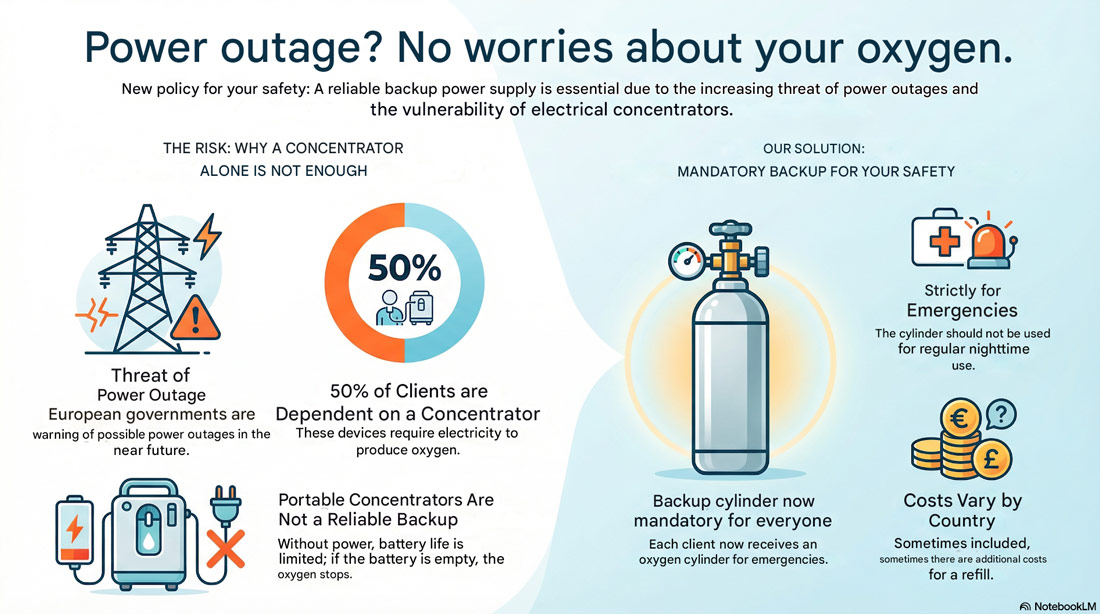
Why a Backup Cylinder Isn’t Optional
You’ve got your portable concentrator for outings, your stationary concentrator at home, and you might feel you’re covered. That’s a great start. But here’s the catch: when the lights go off, your concentrator stops working. And that’s exactly what several European governments and grid-operators are warning about.
In the Netherlands, for instance, the government lists a power outage as one of the core “disasters and crises” that residents should prepare for ( Gobierno de los Países Bajos) Dutch experts have even flagged possible winter outages if the grid gets overloaded.( NL Times ) Meanwhile in Germany, the Federal Network Agency has stated that if the energy transition falters, occasional supply gaps could arise around 2030. ( Reuters ) And in France the transmission operator Réseau de Transport d’Électricité (RTE) warns that while a full blackout is unlikely, targeted power cuts cannot be ruled out during periods of high demand. ( Reuters )
So, for you as an oxygen user, whether retired, living on the Costa Blanca or somewhere else in Europe, this matters. It’s not alarmist; it’s just practical. You’re depending on equipment that needs electricity... and if the power fails, your portable battery only lasts so long.
How Oxygen Supply Typically Works and Where the Risk Lies
Let’s walk through a typical setup many of our clients use:
- At home (or in your holiday property) you’re using a stationary concentrator, which is plugged into mains power and gives you continuous oxygen supply.
- When you go out or travel, you use a portable concentrator (POC) with a battery.
- Many clients assume the POC serves as backup, great for outings but not enough for an overnight power cut at home.
Here’s where the risk creeps in: if there’s a power cut at your place, the stationary unit stops. You switch to your portable unit... but its battery life is limited. After some hours you’ve exhausted the battery. Then what? No oxygen, unless you have another supply option. That’s where the backup cylinder comes in.
Why the Backup Cylinder Is Non-Negotiable
This is the policy we’re asking you to accept, and here’s why it makes sense.
- Independence from the mains supply. A cylinder gives you a source of oxygen that does not rely on electricity. In a power cut, that independence is a lifeline.
- Designated for emergencies. We supply the cylinder as part of the package, but it is only for emergency use. That means it stays sealed, charged (filled) and ready for when your mains-powered concentrator cannot function.
- Why not night-time use instead of the concentrator? We’ve had cases where clients preferred cylinder use at night because cylinders are silent, and concentrators make noise. But regular use of the cylinder (especially when the concentrator is still available) undermines the purpose of the cylinder, leaving you unprotected for the real emergency.
- Backup included: we strive to provide a backup cylinder wherever possible and unless specifically stated otherwise, every quotation for a concentrator includes the backup cylinder. If the cylinder is used in non-emergency circumstances (for example, nightly use when mains power is actually on) extra costs may apply when it’s refilled. We make this clear so you’re aware.
- It’s about your safety, not upselling. We want you to enjoy your stay, your travel, your independent life with oxygen. This isn’t about pushing extras, it’s about ensuring you remain safe, prepared and independent when the unexpected happens.
Practical Tips for You as a Travelling or Expat Oxygen User
Since you may be living abroad or travelling (for example villas in the Costa Blanca, holiday homes, seasonal stays), here are some practical tips:
- Check power reliability at your accommodation. Ask the property or your holiday-home manager whether they have a backup generator, stable supply and reliable wiring.
Keep the portable unit fully charged. Whenever you leave your home or head out for the evening, ensure your POC battery is topped up. It’s your buffer. - Know where the backup cylinder is stored and how to switch to it. Don’t wait until the power is off to figure this out. View it now. Practice if needed.
- Create an “emergency power cut” grab bag. This may include torch, radio, phone charger bank, water, snacks, your oxygen equipment instructions, contact number for us. The Dutch “Denk Vooruit” campaign reminds citizens that power failure is a real scenario. ( Denk vooruit )
- Keep our contact details at hand 24/7. If the power goes off and you’re uncertain what to do, you can call us. We’re here for you.
- Stay personally informed about grid issues. For example, if you hear from local news or accommodation personnel about a planned outage or maintenance, plan accordingly.
What Happens If the Backup Cylinder Is Used and Why the Policy Matters
We’ve already touched on this, but let’s clarify the mechanics:
- The backup cylinder is supplied as part of the package unless stated otherwise.
Its intended use: only when your mains-powered concentrator is out of service (for instance due to a power cut). - If you use the cylinder as a general overnight or daily substitute (when concentrator/mains power is still available) then:
- We must refill the cylinder sooner.
- That may impose extra costs (you’ll be informed in our client letter).
- This preserves the cylinder’s role as “emergency only” and keeps you fully protected for when a real mains failure occurs.
- If you ever doubt when to switch to the cylinder, call us. Better safe. We’d rather show you how and when to use it than leave you guessing.
Why the Grid Warnings Matter for You
I’ve woven in some real-world grid risks above, let’s pull a few out explicitly and tie them to your situation.
- Netherlands: One report flagged that more than 80% of fire stations lack permanent backup power for major outages. That signals how even emergency infrastructure is vulnerable.
Netherlands: Grid operators warn of “winter outages… in very exceptional situations” because households and companies are consuming more electricity (heating, EVs etc) than the distribution centres can handle. - Germany: The Federal Network Agency warns that if the transition to renewables stalls and flexible demand doesn’t rise, gaps in supply could emerge around 2030.
- France: The grid operator RTE states that although a full blackout is unlikely, some power cuts cannot be ruled out in peak demand scenarios.
- France: In September 2024 RTE placed France at “medium risk” of power cuts for the winter if conditions align.
What this means for you: you may be sleeping in a holiday home, or out at dinner while hooked up to your concentrator, but if the mains supply fails, your equipment stops. Having the backup cylinder is your safeguard.
Final Thoughts - Safety, Independence, Peace of Mind
We believe in helping you live the life you’ve chosen, travelling, relocating, enjoying your overseas home with confidence. Using oxygen doesn’t mean staying put or limiting freedom. It means being smart, prepared and supported.
By accepting the backup cylinder and treating it as your safety net, you keep control of the situation rather than being at the mercy of a sudden power cut. It’s not about fear, it’s about readiness.
If you ever have questions,about how to switch cylinders, how to plan for a stay abroad, what to check in your holiday home, call us. We’re here to help you stay safe, independent and empowered.
Thank you for trusting us. Let’s make your next period away smooth, uninterrupted and worry-free.
Frequently Asked Questions (FAQ)
Q1: When exactly should I switch to the backup cylinder?
A1: Only when your mains-powered concentrator has stopped working because of a power failure, or when you’ve been advised by us. Do not switch simply because you prefer the cylinder for quietness. That is meant for emergency use.
Q2: Does the backup cylinder cost extra?
A2: The cylinder is included with your concentrator quotation unless stated otherwise. Extra costs may only apply if you use the cylinder outside the emergency context (e.g., nightly use when mains power is working) and it needs to be refilled sooner as a result.
Q3: How long will a backup cylinder last?
A3: It depends on your prescribed flow rate and the size of the cylinder. We’ll supply you with a filled cylinder and give you an estimate based on your usage. The key: treat it as your backup, not your primary overnight option.
Q4: I’m staying in Spain (or abroad) for several months. Does this policy apply overseas?
A4: Yes. Whether you are in Spain, on the Costa Blanca or elsewhere in Europe, the principle remains the same. Your mains-powered concentrator depends on electricity, and your backup cylinder gives you continuity in case the power fails.
Q5: What if I discover the power is going off ahead of time (scheduled maintenance)?
A5: Great question. Contact us as soon as you have notice. We can advise whether to switch to the cylinder proactively, or if the maintenance is short enough that your concentrator can still be used safely.
Q6: Can I just not take the cylinder and rely on the portable unit battery instead?
A6: We do not recommend that. A portable unit battery is excellent for going out, but not sufficient for an overnight or extended power cut at home. Without the cylinder, you lose the safety margin.

How OxygenWorldwide Helps You Breathe Easy Anywhere in the World
This article covers OxygenWorldwide's services and details who might benefit from them. It notes which countries OxygenWorldwide has the best relationships with, and offers a host of practical advice on how to get in touch, organise a stay away from home, and provides some caveats and restrictions. The article invites prospective clients to get in touch with the company to learn more about the services on offer and to discover what help may be available to them.
Travelling With Oxygen Shouldn't Be Complicated – Here's Why
If you rely on oxygen for your health, the thought of travelling abroad can be daunting – what if something goes wrong with your supply? There are so many factors to consider that it can seem safer just to stay at home. Forever. But it doesn't have to be that way. You can be a medical oxygen user and still explore the world safely. All you need is the right support: and OxygenWorldwide is on hand, waiting for become the trusted partner who can make sure your travels are as fun and enjoyable as you would like them to be. Read more about OxygenWorldwide and their oxygen travel services here.
Challenges of Travelling with Medical Oxygen
Travelling with medical oxygen introduces a lot of bureaucracy into your journey: from the various regulations about oxygen access, use and transportation which can differ from country to country, to the stringent airline rules, prescription requirements and – of course – being able to tap into local supplier networks – where on earth do you start?
Start with OxygenWorldwide, of course! OxygenWorldwide has been in the business of oxygen delivery worldwide, connecting travellers with their necessary oxygen, for decades and has a good grasp on many regulations and a great network of local suppliers in a host of countries. (Disclaimer: while OxygenWorldwide is well-versed in the rules and regulations of many countries and airlines, it is always up to the client to do some research and make sure that their specific oxygen setup will be compliant and appropriate.) Check out these travel tips for more information.
What OxygenWorldwide Actually Does for You
1 Global Coordination
- OxygenWorldwide works with the abovementioned international network of suppliers to deliver oxygen in the destination country as and when it will be needed.
- Travellers can access everything from cylinders (varying sizes) to LOX to portable oxygen concentrators (POCs) as long as they have an appropriate prescription and the requirements don't contravene local regulations.
2 Communication is Key
- OxygenWorldwide has multilingual assistants waiting to chat in English, Spanish, French, German and Dutch, so nothing is lost in translation between the traveller and the oxygen supplier.
3 Logistics and Documentation
- OxygenWorldwide can help guide travellers through airline forms, medical documentation requirements and assist in liaising with hotels and hospitals.
- Fill in this form if you have any questions: contact and enquiries.
Emergency Assistance and Peace of Mind
OxygenWorldwide has multilingual employees, as mentioned above, but it also operates a 24-hour helpline from which travellers can seek guidance while on their holiday. Travellers to Spain, Portugal and certain regions in France can especially benefit from this helpline, but do be aware that it is only for existing customers: travellers cannot make their own arrangements and then access OxygenWorldwide's support without a previously established relationship.
Travellers who use or will need to use medical oxygen abroad should go ahead and set up that relationship though: here's why OxygenWorldwide is a great partner to choose.
Beyond the Holiday: Support for Hospital Discharges and Long-Term Stays
It is not only holidaymakers who can take advantage of OxygenWorldwide's services. Sometimes people who have been ill in hospital abroad and who are being released with an instruction to use medical oxygen at home for a period of convalescence will need to contact OxygenWorldwide to help them manage their new needs. OxygenWorldwide also coordinates temporary and permanent medical oxygen support for travellers as well as for expats or pensioners who have moved to a new – warmer, cheaper – country for their golden years if they need to establish or maintain medical oxygen supply lines.
Your Oxygen, Your Way
Oxygen arrangements can be tailored to meet travellers' specific needs. For example, people might receive oxygen in various formats, all designed to work best over a set period of time:
Short stays benefit from the use of portable concentrators (light, portable, excellent for day trips and excursions) and cylinders (varying sizes for use in accommodation and overnight, with variable flowrates from low to high)
Longer stays – a week or two, for example – can again use POCs for the daytime travels and excursions, with larger cylinders or LOX tanks for home and overnight use. LOX or liquid oxygen is a bright blue fluid that 'boils off' into oxygen gas. It is highly compressed and is a great way to have a good quantity of oxygen on hand in a relative small (but heavy) space. However, it is also explosive if mishandled, and will not be permitted on a plane, and can be tightly regulated depending on the destination country.
Cruises and tours can use most types of oxygen equipment, but you will need to coordinate refills and deliveries to coincide with port calls. OxygenWorldwide can help with various Mediterranean and European river cruises. Click here for more information: cruises and multi-Country Tours.
How Real Travellers Explored Without Worry
Anne* suffers from emphysema and asthmatic conditions and has a diagnosis of COPD. While she is relatively mobile during the day, using preventive and relieving inhalers, she relies on an oxygen cylinder at night to keep her sleeping easily. Lying down without medical oxygen leaves her dangerously short of breath and she constantly wakes up, struggling to catch her breath – all of which leaves her exhausted and out of sorts. OxygenWorldwide helped Anne source a POC to take on her flight – she wasn't sure if the low oxygen levels on board the plane would exacerbate her symptoms and (understandably) wasn't prepared to risk falling ill – and helped establish contact with a local supplier to keep her night cylinders topped up until the end of her holiday.
OxygenWorldwide delivered the POC to the airport in time for Anne's flight, and arranged to have oxygen cylinders ready and waiting in her hotel room – they did this by coordinating with the hotel management and the oxygen supplier, ensuring that all parties knew what was expected of them and by when.
Anne said: 'OxygenWorldwide gave me the confidence to go on a foreign holiday for the first time since my diagnosis. I loved every minute of my time in Spain – Barcelona is beautiful and the countryside even more so! I am already planning my next holiday, and OxygenWorldwide was the first call I made.'
*Not her real name
How to Arrange Your Own Oxygen Supply with OxygenWorldwide
Once you've chosen your destination and tentatively picked out a hotel or accommodation, you should get in touch with OxygenWorldwide sooner rather than later. Here's the step-by-step process:
- Fill in the enquiry form, completing your travel dates and any prescription details (you will need to ensure that your prescription is in-date for all your destination country's requirements.
- OxygenWorldwide contacts local suppliers in the area, and gives you a quotation.
- You will confirm the quotation, and future delivery will be set into action.
- Once you are about to head off on holiday, you will be given access to the 24-hour emergency phone, for use should anything go astray during your travels. This could be anything from needing to switch hotels due to emergencies, needing to increase or decrease your supply and anything in between.
Why Should YOU Trust OxygenWorldwide?
OxygenWorldwide has over thirty years of global experience, and has, in that time, established excellent industry connections with oxygen and equipment suppliers, medical and travel insurers and even with hospitals and medical treatment centres all over the world. Their staff are invested in their clients' wellbeing and take steps to ensure that everything arranged so that oxygen and users end up in the right place at the right time for trouble-free travelling. The multilingual staff literally speak your language, and care deeply about ensuring that travelling with medical oxygen is as easy possible for their customers.
If all of that isn't enough, here are some more reasons why OxygenWorldwide is your best travel companion.
To conclude, needing to use medical oxygen shouldn't be a life-limiting experience. You should be able to travel to just about anywhere, and enjoy holidays and sightseeing if you want to. And you can, with the right planning and partnerships in place: if you're ready to plan your next trip? Contact OxygenWorldwide and let us take care of the rest!
FAQs
Q: What happens if the oxygen I ordered doesn't arrive?
A: This is extremely rare, but should something go awry with the arrangements OxygenWorldwide has put in place, our 24-hour helpline is in place and can help make emergency arrangements to ensure you are not without your necessary oxygen for long. (Do note there are some countries where OxygenWorldwide has more limited contacts and that backup plans for these countries should be discussed in advance.)
Q: My hotel has flooded and I'm being moved to a sister hotel one town away. What happens to my arrangements?
A: Contact us as soon as possible when you learn of circumstances like these: our staff will immediately leap into action to divert your existing oxygen supply plan, or put into place a temporary one so you do not experience too much disruption.
Q: I'm not signed up with OxygenWorldwide, but I am on holiday already. Can I call your emergency line if my plans don't work out?
A: Unfortunately, you can't. The OxygenWorldwide helpline is purely for existing customers for whom we will have all the details of their medical condition and needs. We cannot take on a new customer in a foreign country at short notice – the logistics simply will not allow for a satisfactory experience.
Q: What paperwork do I need to travel with medical oxygen?
A: Most countries require an up-to-date prescription. Some may require a 'fitness to travel' letter, confirming that you are chronically ill, but capable of travelling without too much issue. You may also need a medical letter to confirm your diagnosis and the recommended treatment, as well as operating instructions for your medical equipment.

A Guide to EHIC/GHIC for European Travellers with Medical Needs
If you rely on medical oxygen, the idea of travelling in Europe might feel complicated. Fortunately, both the EHIC and GHIC cards offer a valuable safety net—but they’re not a magic wand. This guide explains how they work, what they cover for oxygen users, the recent updates you need to know, and how to integrate them into your travel planning. With proper preparation you can travel more confidently and focus less on logistics and more on enjoying your time away.
Introduction
When you’re using medical oxygen and thinking about travelling in Europe, the last thing you want is an unexpected hiccup with healthcare coverage. The good news: if you’re eligible for a EHIC or GHIC card you have access to state-provided healthcare in many European countries (including the UK) on the same terms as locals.
But—and this is important—there are limits, caveats, and details that matter to anyone using medical oxygen.
In this guide we’ll walk you through the rules (including recent updates), highlight what it means for oxygen users, and show you how to plan smart so your travel is safer and more enjoyable. Internal links to relevant OxygenWorldwide pages will help you apply these tips to your oxygen setup.
What are EHIC and GHIC—What’s the difference?
The EHIC is the European Health Insurance Card (E111/E112) and the GHIC is the Global Health Insurance Card (GHIC). Both give you access to medically necessary state healthcare in certain countries when travelling temporarily.
Here’s the nutshell version:
- If you hold a valid EHIC (issued before the UK left the EU) you can still use it until it expires.
- If you’re eligible for a GHIC (and many UK residents are) you should apply for it because it has largely replaced the EHIC for UK-residents.
- Neither card replaces travel insurance. They cover state-provided healthcare under public systems, not private clinics, repatriation, or many other costs.
Recent update to highlight
In April 2025 the UK guidance for applying for healthcare cover in the EEA was updated (form process, who should use the form, etc).
Also, roughly two million UK EHIC/GHIC cards are set to expire in 2025, potentially creating gaps in coverage if not renewed.
If you’re using oxygen services abroad, this is a detail you cannot ignore.
Where they work—and where they don’t
If you’re travelling with medical oxygen, knowing where your card works is critical.
- The EHIC/GHIC covers state-provided healthcare in the 27 EU countries plus Iceland, Liechtenstein, Norway and Switzerland in many cases.
- Example: In the UK government’s foreign travel advice for Spain, it explicitly states “A GHIC or EHIC is not an alternative to travel insurance”.
- Be aware: Coverage is for medically necessary treatment under the host country’s public system; it does not guarantee everything for someone using oxygen (e.g., private oxygen equipment hire, repatriation).
- If you’re resident in the destination country (for example living in Portugal long-term) you may not be eligible to use a UK-issued EHIC/GHIC.
What it means for travellers using medical oxygen
If you’re using oxygen (cylinders, liquid, or portable concentrator) here’s why this matters—and what to watch.
Why it matters
- Oxygen users may have higher needs for medical care while abroad, so the fallback of state-provided care is an extra layer of security.
- In case of unexpected hospital admission or exacerbation of breathing issues, your EHIC/GHIC can cover state treatment costs under the local system.
What to watch
- Your oxygen supply, equipment hire, and any “non-standard” medical services may not be covered by the EHIC/GHIC. So you’ll still need specialist arrangements for oxygen delivery and equipment.
- Always carry your prescription, doctor’s letter, and any documentation of your oxygen setup.
- Use a provider like OxygenWorldwide to arrange oxygen delivery, local supplier coordination, and backup support. (See our Enquiries page)
- Confirm with your travel insurance that oxygen therapy and any medical evacuation are covered. The EHIC/GHIC will not handle those extras.
Step-by-step checklist for oxygen travellers using EHIC/GHIC
Here’s a practical checklist you can follow:
- Check your card – Does it expire in 2025 or soon? Renew if it does.
- Bring your oxygen documentation – Prescription, flow rate, equipment details, note from doctor.
- Confirm your destination eligibility – Is the public healthcare system part of the EHIC/GHIC scheme? Are you eligible as a temporary visitor, not a resident?
- Arrange oxygen supply ahead of arrival – Use your provider to coordinate local delivery.
- Purchase comprehensive travel insurance that includes oxygen therapy, equipment failure, and evacuation.
- On arrival – Carry pointer contact info for your oxygen supplier and local hospital; keep your card with you at all times.
- If treatment is needed – Present your EHIC/GHIC first, inform your oxygen provider and insurer, and follow local public system protocols.
Latest tips and considerations
- Renewal urgency: With many cards expiring in 2025, renewal should be one of the first items on your travel-preparation list.
- Not a stand-alone cover: Re-emphasising—card does not cover repatriation, private clinics or evacuation. If you require oxygen therapy abroad, these extras are vital.
- Residency caveats: If you move abroad or become resident in another EU country, your EHIC/GHIC usage may change.
- Equipment arrangements: The card covers “state-provided healthcare” but your oxygen setup is typically private logistics—so rely on a specialist like OxygenWorldwide to sort equipment and delivery.
- Language and local systems: You may face language or system differences when presenting the card in a different country; printing a tri-lingual summary of your condition and showing your equipment documents helps.
How OxygenWorldwide helps you integrate EHIC/GHIC into your oxygen travel plan
At OxygenWorldwide we specialise in oxygen travel logistics. Here’s how we help oxygen users work with EHIC/GHIC and travel abroad:
- We review your oxygen-equipment plan and destination and check if your healthcare cover aligns with EHIC/GHIC rules.
- We handle supplier liaison—so you don’t need to manage local oxygen hire, delivery, or storage.
- We provide multilingual support (English, Spanish, French, German, Dutch) so you’re not on your own in another country.
- We manage backups and emergencies (in countries such as Spain, Portugal and parts of France) so you can travel with peace of mind. See our Por qué OxygenWorldwide page for full details.
You might still need private insurance, but with the EHIC/GHIC card as a foundation and our services for oxygen, your trip becomes far smoother.
FAQs
Q1: Can I travel with oxygen in Europe using only an EHIC or GHIC?
A: Unfortunately, no. The card can cover state-provided healthcare if you need treatment, but it doesn’t replace arranging your own oxygen equipment, delivery or insurance.
Q2: My EHIC is expiring this year. What should I do?
A: Apply for a GHIC if eligible (free via NHS) and keep your old EHIC valid until its expiry date. Check NHS website for the latest renewal process.
Q3: Does the EHIC/GHIC cover private oxygen hire or excess oxygen costs abroad?
A: No. The card covers state-provided healthcare, not private equipment hire. That portion remains your responsibility.
Q4: I live long-term abroad in Europe. Can I still use a UK GHIC or EHIC?
A: It depends on whether you’re considered a temporary visitor or a resident. If you’re a long-term resident, you may need local health coverage instead.